FinTech + Market Structure Analysis + Behavioral Trading4/21/2026
Financial Markets Evolution in 2026
A
admin
Financial Analyst
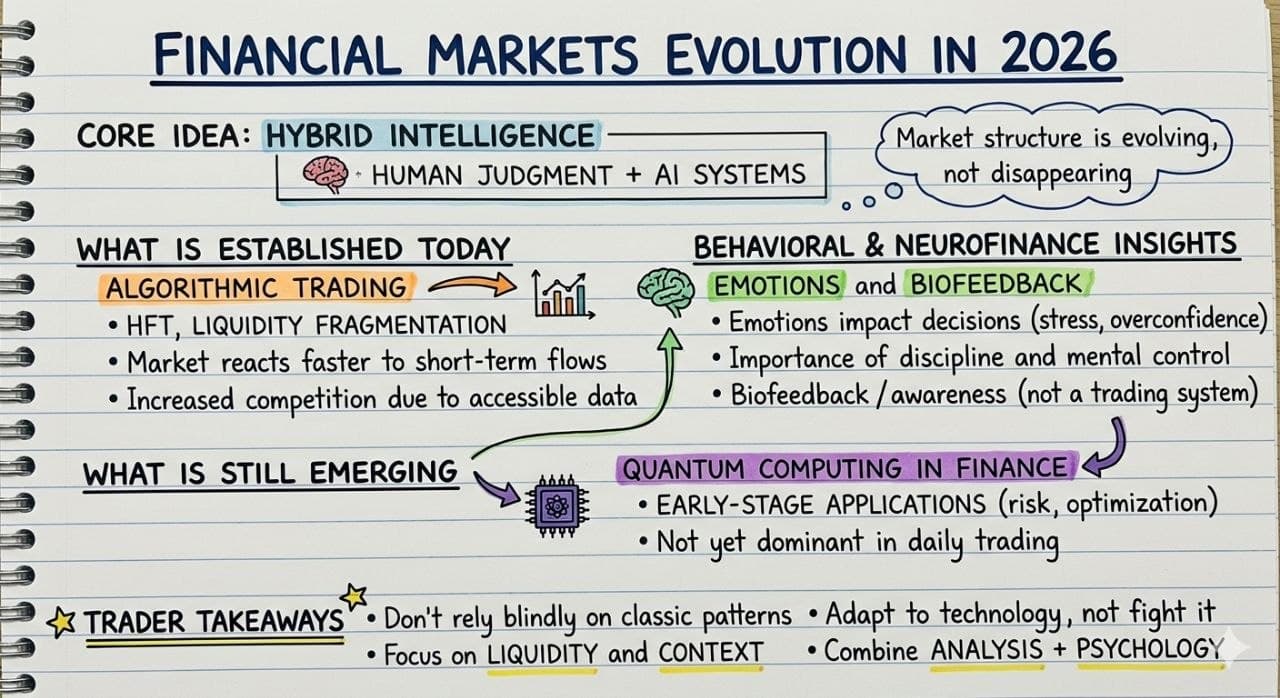
Financial Markets Evolution in 2026: Between Neurofinance and Quantum Computing
Introduction
In 2026, financial markets are being shaped by more than faster execution or sharper indicators. The deeper change is structural: markets are increasingly influenced by automation, non-bank participation, digital asset flows, and the early groundwork for quantum-era infrastructure. The result is a market environment that still rewards analysis, but punishes rigid thinking. The key question is no longer whether technology matters, but how it changes liquidity, risk, and decision-making.
The Core Idea: Technology as a Market Shaper, Not a Full Replacement
The central idea in 2026 is hybrid intelligence. Human judgment has not disappeared, and neither has technical analysis, but the market now operates inside a system where algorithms, data infrastructure, and automated execution affect how price moves. BIS research on foreign exchange markets shows that algorithmic trading and market fragmentation are important structural features of modern FX, while liquidity conditions can be more fragile under changing market regimes.
That does not mean classic chart patterns have become useless. It does mean they must be read in context. In a market with more automation and faster reaction times, the quality of a setup depends not only on its shape, but on where liquidity sits, how the session is behaving, and whether broader market conditions support the move.
What Is Clearly Established Today
Algorithmic trading is now a defining part of the FX landscape. BIS survey material and related research describe global FX markets as highly transparent in structure but heavily shaped by modern execution methods, including automated trading and intermediation outside traditional banks. This changes how short-term price discovery works and helps explain why intraday moves often look more aggressive and less “clean” than older retail-style chart examples would suggest.
Another established reality is that trading is not purely mechanical. Research in neuroeconomics and neurofinance shows that financial decisions are influenced by emotion, reward processing, stress, and other psychophysiological factors. Studies of trader physiology and decision-making suggest that mental state can be linked to market behavior, which supports the idea that discipline and emotional control are part of performance, not a side topic.
A third reality is that market access is broader than before. Retail participants now have access to charting, execution, and data tools that were once institutional advantages. That democratization improves access, but it also increases competition and makes weak methods easier to expose. More tools do not automatically create better decisions.
What Is Still Emerging
Quantum computing is important, but it should not be described as a fully mature trading infrastructure in 2026. BIS research describes quantum computing as a future opportunity and a future risk, especially for cryptography, optimization, and certain financial computations. However, the same research makes clear that the technology remains early-stage and that the financial system is still in the phase of preparedness, experimentation, and transition planning.
The practical implication is simple: quantum computing is relevant today mostly as a strategic horizon, not as a daily retail trading edge. Financial institutions are already thinking about quantum-safe cryptography and post-quantum transitions, which shows that the industry is preparing for disruption before it fully arrives. That is very different from claiming that quantum systems already dominate market microstructure.
What Traders Should Pay Attention To
First, classic patterns should not be treated as fixed laws. In a more automated market, a familiar pattern can still work, but it can also become a liquidity trap if too many participants see the same structure. The real edge comes from context: liquidity location, session timing, and the quality of the move behind the pattern.
This follows from the way modern FX markets are described in BIS research on fragmentation, execution, and liquidity behavior.
Second, psychological control matters more than many traders admit. The science of decision-making supports the idea that stress, emotional bias, and reward sensitivity shape financial choices. That does not mean every trader needs neurotechnology, but it does mean that emotional regulation, focus, and routine are part of a serious trading process.
Third, traders should learn enough about automation and digital infrastructure to avoid being blind to the environment they trade in. Stablecoin flows, market fragmentation, and the expansion of machine-driven execution are all part of the background that influences price behavior. Even when a trader does not use these systems directly, the market already does.
Conclusion
Trading in 2026 is not impossible. It is simply different. The market is more automated, more interconnected, and more sensitive to structural shifts than before. The best response is not to romanticize old methods or chase futuristic buzzwords. It is to combine market structure awareness, disciplined execution, and psychological control with a realistic view of what technology can and cannot do. In this environment, the advantage belongs to the trader who adapts without exaggeration.
References
Bank for International Settlements, Quantum computing and the financial system: opportunities and risks (2024).
Bank for International Settlements, Quantum-readiness for the financial system: a roadmap (2025).
Bank for International Settlements, Project Leap and quantum-proofing materials (2023–2025).
Bank for International Settlements, Global FX markets when hedging takes centre stage (2025).
Bank for International Settlements, Through stormy seas: how fragile is liquidity across asset markets? (2024).
Bank for International Settlements, Stablecoin flows and spillovers to FX markets (2026).
Raggetti, G. M., Editorial: Neurofinance (2021).
Dennison, J. B., et al., Decision neuroscience and neuroeconomics: Recent advances (2022).
Singh, M., et al., Real-time extended psychophysiological analysis of financial traders (2022).
Bossaerts, P., et al., How Neurobiology Elucidates the Role of Emotions in Decision Making (2021).
#Trading
#Forex
#forexmax
#FinancialMarkets
#Investing
#MarketAnalysis
#AlgorithmicTrading
#MarketStructure
#FinTech
#AITrading
#QuantumComputing
#FutureOfFinance
#TradingPsychology
#TraderMindset